
8/1 Forecast
1. Pressure System
1. Surface Pressure


-
Low-pressure systems are located north of the Korean Peninsula, over inland China, and southeast of Japan, indicating that the Korean Peninsula is currently under the influence of these low-pressure areas.
-
The low-pressure system north of the Korean Peninsula is expected to move eastward, reducing its impact on the peninsula. At 09 KST, the low-pressure system located east of China has weakened or dissipated.
-
Meanwhile, the North Pacific High is expanding southwestward, which is expected to increase its influence on the Korean Peninsula
2. 925hpa


-
Warm advection is occurring over the Korean Peninsula, with southwesterly wind bringing in warm and humid air.
-
Overall, temperatures across the peninsula range from 21 to 24°C.
-
By 21 KST, temperatures rose to 24–27°C, likely due to the influence of warm advection.
3. 850hpa


-
Warm and humid air from inland China continues to flow into the Korean Peninsula following southwesterly winds.
At 09 KST, a warm zone with temperatures around 21 to 24°C has formed across the entire peninsula.
-
By 21 KST, the warm zone expanded northward. Daytime heat trapped aloft makes nighttime cooling difficult, raising the chance of tropical nights.
-
The low-pressure system over northern Korea moved east and is expected to move further away.
2. Wind
850hPa Stream Line & Isotach


-
Southwesterly winds dominate over the Korean Peninsula, bringing in warm and humid air.
-
Warm advection occurs as the air flows along the isobars, influencing the temperature increase.
-
Since wind speeds are mostly below 25 knots, the winds are generally weak.
This allows the warm and humid air brought in by warm advection to be trapped, resulting in the accumulation of radiant heat.
3. Precipitation/humidity
K-index

There will be no rain in most areas due to the lack of a clear precipitation induction factor and the possibility of thunderstorms is very low. However, there is a possibility of weak topographical rain in Gangwon-do
01
850hPa Moisture Flux
-
The flow of water transport in the southwest or southeast direction throughout the Korean Peninsula
-
it is unlikely to lead to precipitation because it is an overall uniform flow
03
850hPa Streamline and Isotach
-
Presence of lower jets over the West Sea
-
Wires are relatively stagnant weak flows on the Korean Peninsula, with weak convergence or divergence.
02
1000-500hPa Thickness & 700hPa T-Td
-
Thickness line ranges from 5820 to 5880 gpm, a typical summer warm atmospheric layer structure.
-
no clear wet zone was observed.
04
K-index
-
Gyeonggi, Chungcheong K Index 25-30, weak local showers are possible.
-
The South is very stable
4. Cloud

-
Upper-level clouds forming a bright and distinct band have been observed mainly over northern Gyeonggi Province and northern Gangwon Province.
-
Lower-level clouds, which appear less bright and more diffuse, have been observed over central and southern parts of the Korean Peninsula and the southwestern seas.
5. Temperature
2024.08.01 | 09KST

As of 9 AM on August 1st, we follow the dry adiabat line from the 850 hPa temperature on the thermodynamic chart down to the surface, the maximum temperature is expected to be approximately 33°C.
2024.07.31 | 21KST
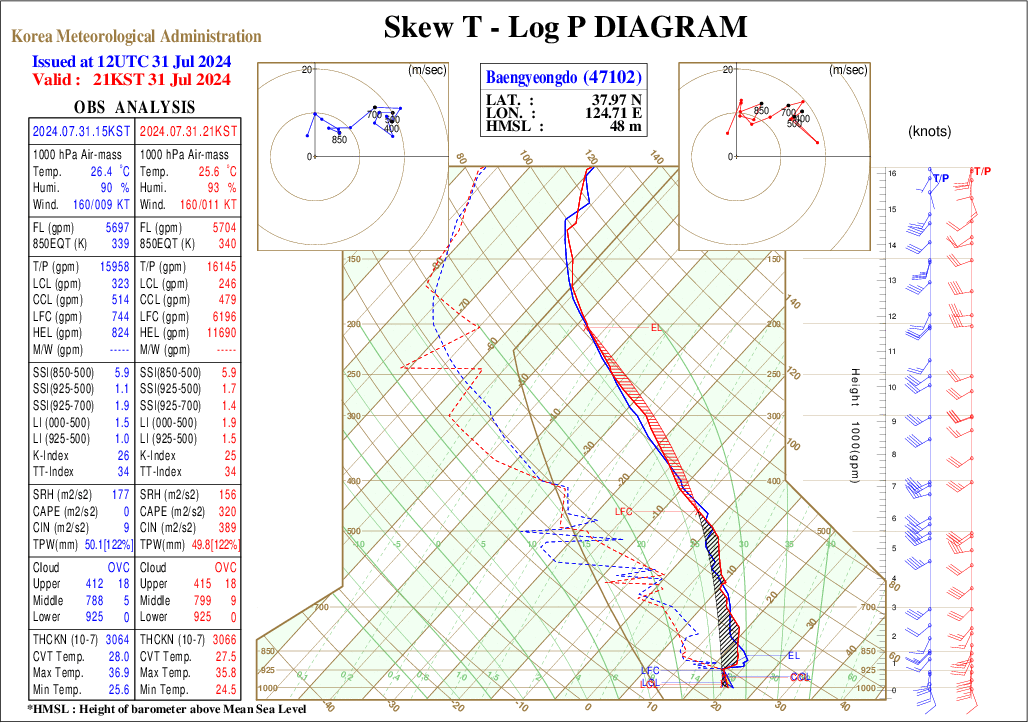
As of 9 PM on July 31st,
the minimum temperature in Seoul on August 3rd is expected to be approximately 24°C.
8/1 Observation
1. Wind


2. Precipitation

Most of the country was clear without precipitation, but there were showers in the northwestern part of Gyeonggi Province
3. Temperature


-
Climate deviation
→Parts of the central interior of North Korea and the Korean Peninsula were colder than usual and the rest were hotter than usual
-
Standard score
→Z-Score is 0.25, 0.5 or higher in most of the countries with some parts lower than 0.
-
8/1 overall higher than normal temperatures
-
Maximum temperature 33.2°C, 2.3°C above last year (30.9°C)
-
Minimum temperature is 27.3°C, 3.0°C above last year (24.3°C)